Saturday, March 10, 2018

Oral Law- Jordan Spiegel

Leviticus, chapter 19, line 34: The stranger who resides with you shall be to you as one of your citizens; you shall love him as yourself, for you were strangers in the land of Egypt. 
This mitzvah is about loving and helping everyone in the world, regardless of any differences you might have. Race, religion, sexual orientation, nationality-none of it truly matters in the grand scheme of things. The most important thing we can do as human beings is look past these differences and find the love in our hearts to treat everyone as we treat ourselves. In modern day life, fulfilling this mitzvah could be anything, from respecting those with different opinions and treating them as an equal in your home, to accepting refugees into your land. Part of the reason this is such an important Jewish value is because we wandered the earth for thousands of years without a country to call home. Before the Jewish people had ‏ארץ ישראל we had to rely on being accepted into other cultures by other peoples. If Jews don’t accept  foreigners, we are forgetting our past, when we were foreigners in many lands.

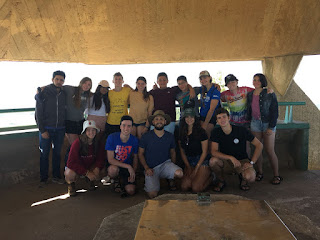
I took this picture after our morning Shabbat service. There were some orthodox girls who were sitting and watching us pray. I waved and they waved back, and before we left I figured it would be a perfect picture opportunity (me being a reform Jew and completely forgetting that they might not want to take a picture on Shabbat. Lucky I asked, and they were fine with it, even if I got reprimanded for it by the madrichim.) Although it’s a somewhat goofy picture, I think it captures the essence of the mitzot of accepting the foreigner. We are both different sects of Jews with different customs, and I am living in their homeland. I barely speak Hebrew and they barely speak English, but we were able to connect with each other over morning prayer, and by making a silly hand heart. In this moment, we accepted each other despite all our differences. The mitzvot commands us to love the foreigner, and that’s what the Jewish people need to do, one connected hand heart at a time. 

Thursday, March 8, 2018

Oral Law- Sam Banen


'You shall not render an unfair decision: do not favor the poor or show deference to the rich; judge your kinsman fairly'" (Leviticus 19:15). Give to all of those who are in need, not just those who you deem as deserving. "You often say, 'I would give, but only to the deserving.' The trees in your orchard say not so," (Gibran 21) for the trees in your orchard give fruit without hesitation, and like the trees, you too shall give. But what of those who can support themselves and their family and the families around them? What more do they need? Everybody has something to offer to somebody. "It is when you give of yourself that you truly give" (Kahlil Gibran 19). The gift of one's self is greater than anything else. You have your friendship, your time, your wisdom to give to someone in need of it, and these things do not come to the rich or poor with preference. Also, think of the song Lean on Me by Bill Weathers and think about how it's all about needing a friend. Now think about how there has never been a song about donating to charity


I have here a picture of a “homeless” man (Michael) and a fruit tree. The homeless man is accepting the fruit of my tree just like the hand in the picture on the right. I picked up Kahlil Gibran’s quote about the fruit tree from his book, “The Prophet.” To me, his quote painted a beautiful picture of the state of being in a natural world; consumers take from the plants around us without hesitation, predators take from herbivores without hesitation, decomposers take from dead animals without hesitation, and even plants take from the decomposers and the sun without hesitation. It’s how the world works, and to me, nothing is more beautiful.

Oral Law Tiyul- Shay


Hello everyone!
On Tuesday we went on the Oral Law Tiyul up North to some amazing sites. Some of us had parents or other family members that joined us on our learning adventure and it was fun to give them a taste of our daily life here at Heller High. Our first stop was Beit She’arim (House of Gates), a Jewish burial site from around the year 200 CE. This archaeological site contains hundreds of rock-cut tombs, many that are adorned with elaborate designs, symbols and figures. The four corners of the sarcophagi lids symblolize the four corners of the Temple altar and the four corners of the world. On some of the sarcophagi there are wreaths, the Roman symbol of infinity, symbols of Nike, the Roman goddess of victory, and symbolistic animals such as cows, lions and eagles. These adornments were most likely a result of the influence of GrecoRoman culture on our Jewish ancestors, however; many of us were still surprised to see these symbols and idols. Throughout the Tanach, God continually reminds us not to do Avodah Zara, Idol worship, and punishes us harshly when we do, so how could these figures and symbols be accepted by God and the Rabbis of Judaism?


In the burial caves there is also a giant Menorah carved into the stone wall. This Jewish Kosher symbol proves that this was indeed a Jewish burial site and that Judaism was still a strong part of these ancient people’s identity despite the Roman influences depicted on their sarcophagi.


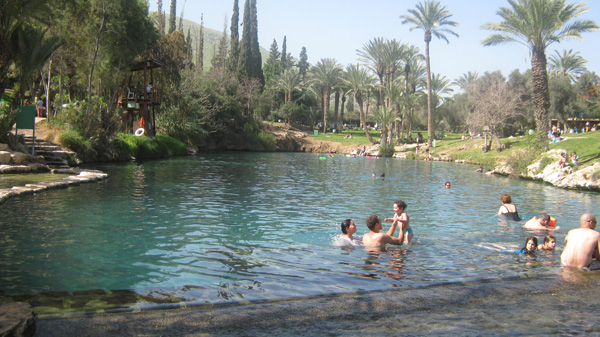
We then went to Sachne where we ate a picnic lunch and went swimming in a beautiful lagoon. It was fun to sit on the rocks with the fish bitting the dead skin off our feet or lay out in the sun with our family and friends.
Image result for sachne israel


Our final stop was to Synagogue Beit Alpha which houses a very well preserved mosaic. We watched a short video about the Synagogue’s history and then Shira taught us more about it. The mosaic has three sections: the depiction of the sacrifice of Abraham and Isaac, the Zodiac Calendar with the Greek sun God Helios inside of it, and the Holy Ark with sacred objects from the Temple. This threefold mosaic is said to represent the past, present and future of the Jewish people; the past being the matriarchs and patriarchs of biblical times, the present being the influence of Hellenism on Jewish culture, and the future being the hope for a third temple and the growth of the Jewish people. Parallel to the catacombs at Beit She’arim, the same question can be asked about how the Jews rationalized these GrecoRoman idols and symbols.


After the Bar Kochba revolt, the SanHedrin moved to Tiberius and then to Bavel. Since Oral Law was at risk of being forgotten without a centralized place to pray, Jehuda Hanasi published the Mishnah. The Mishnah consists of six orders that state aspects of Jewish life and law.
In the Mishnah the Rabbis wrote rules of how to live a Jewish life despite the GrecoRoman influences by addressing how Jews could trade, work and worship with the other religions. For example, in Chapter 1 Mishnah 7 the Rabbis wrote that Jews, “Should not join them (Romans) in building a basilica, a scaffold, a stadium, or a platform”.  After taking a bath in a bathhouse dedicated to Aphrodite, Rabban Gamaliel sets ground rules for interacting with symbols from other religions in Chapter 3 Mishnah 4 by writing, “I did not come into her domain, she has come into mine. People do not say, ‘the bath was made as an adornment for Aphrodite’; rather they say, ‘Aphrodite was made as an adornment for the bath.’" In the quote the Goddess Aphrodite is treated as art and not an idol. Rabban Gamaliel is saying that it is fine for Jews to be around figures and symbols as long as they are a part of popular culture and no longer part of the religious domain. This is one way the depictions of Gods and symbols on the sarcophagi and the mosaic at Beit Alpha were rationalized by the Rabbis.


As teenagers growing up in the US/Canada, very culturally and religiously mixed countries, sometimes aspects of American/Canadian society clash with our religious practices and beliefs forcing us to make hard choices. In our discussion, we were given certain situations that might put our Judaism practices at risk, and we had to decide where our own red lines stood. One of the situations was what would you do if there was a sporting event or a school dance on Yom Kippur? I personally drew a red line there and would have refused to go if presented with this situation. These situations led to discussions over what parts of Judaism and American culture are important to us and since both are integral parts of our identities these decisions were challenging to make.

So I will leave with you all with a question: Do you think the changes the Rabbis made in the Mishna about Jewish life and culture were rationalized and how can you rationalize your own hard choices when balancing your identity as a Jew and member of Western Society?


Bar Kochba Tiyul - Batya Salomon

On Wednesday February 28, we traveled to Bar Kochba, the location of the Bar Kochba Revolt from 132-135 CE. Relations between Romans and Jews had been okay for a bit, but they started to deteriorate. The Roman leader at the time was Hadrian, and he made a long list of decrees that forbade Jewish practices. It is unclear whether this was a cause or effect of the revolt, but it cannot be debate that they upset the Jews. The Bar Kochba Revolt was the first major revolt since the Great Revolt and the destruction of the Second Temple, but it was very different.
The Great Revolt was extremely disorganized and driven entirely by anger. The Bar Kochba Revolt had been planned out and organized thoroughly. We got to see this first-hand by going into one of the cave tunnels used by the Jews. The tunnels were small but branched out into larger rooms. The rebels would go out and fight a battle, and then they would return to the caves where the Romans couldn't find them. They also stockpiled weapons. They would purposefully make weapons poorly so the Romans would reject them, and then they would keep them for themselves. This showed the good leadership they were under which is also who the revolt was named for.

The main leader was Bar Kochba. His name was originally Bar Kosiba, meaning "son of Kosiba," but Rabbi Akiva and others saw him as very important and even as the messiah, so he was renamed Bar Kochba, meaning "son of star." He led this organized revolt successfully for a while, even gaining Jerusalem, but they were eventually defeated on the 9th of Av in 135 CE, which proved that he was not the messiah. They then called him Bar Kosiva which means "son of disappointment."
After going through the Bar Kochba caves, we went to Beit Guvrin, where there is an amphitheater and a church-turned-mosque. We played a "gladiator game" inside the amphitheater and saw ruins of the place where there were bathhouses and rooms for gladiators to be held before going out to fight. We sat in one of those rooms and learned about Rabbi Akiva.
Rabbi Akiva was and still is extremely influential to Jews. We talked about how he was supposedly illiterate until the age of forty. When he was newly married, he left his wife for seven years to go study Torah. When he returned with 10,000 students, his wife told him to go off again to get more. He became a huge success, and is still considered one of our greatest sages. During the revolt, he had claimed that Bar Kochba was the messiah, but he was wrong. When the Romans banned practicing and teaching Judaism, he refused to listen. For contributing to the revolt and continuing to practice Judaism, he was combed to death with iron in a Roman amphitheater, like the one we were in, along with nine other rabbis.
This tiyul was really fun and interesting, yet it was bittersweet. I love caves, so crawling through the ones used so long ago was really amazing. However, it was sad to think of how the people who lived in these caves were fighting for their culture, and they lost and were killed. Playing a gladiator game where the goal is to knock people's hats off is fun, but to think of how people were put out there to actually kill each other is really surreal. It was even weirder to see the fake people cheering it on and to think about the real people who were there so long ago. Some of the people in those crowds were Jewish.
This leads me to my questions.  Do you think that it was okay for Jews to go to these Roman sporting events and watch people kill and be killed? Was it actually acceptable or just something they did anyway? If you lived back then, do you think you would go?

Wednesday, March 7, 2018

Weekend in Eilat

     Before arriving in Eilat, we stopped to hear the reading of the Megillah. When we arrived, we found ourselves entering a small room and we were welcomed by a small, reformed community. We were selected to act out the story of Esther. It was a very entertaining version of the Purim story. Later that night we arrived at our hostel, with a view of the Gulf of Eilat. On the other side of the Red Sea is the city of Aqaba, Jordan, who considers the Gulf of Eilat, the Gulf of Aqaba.
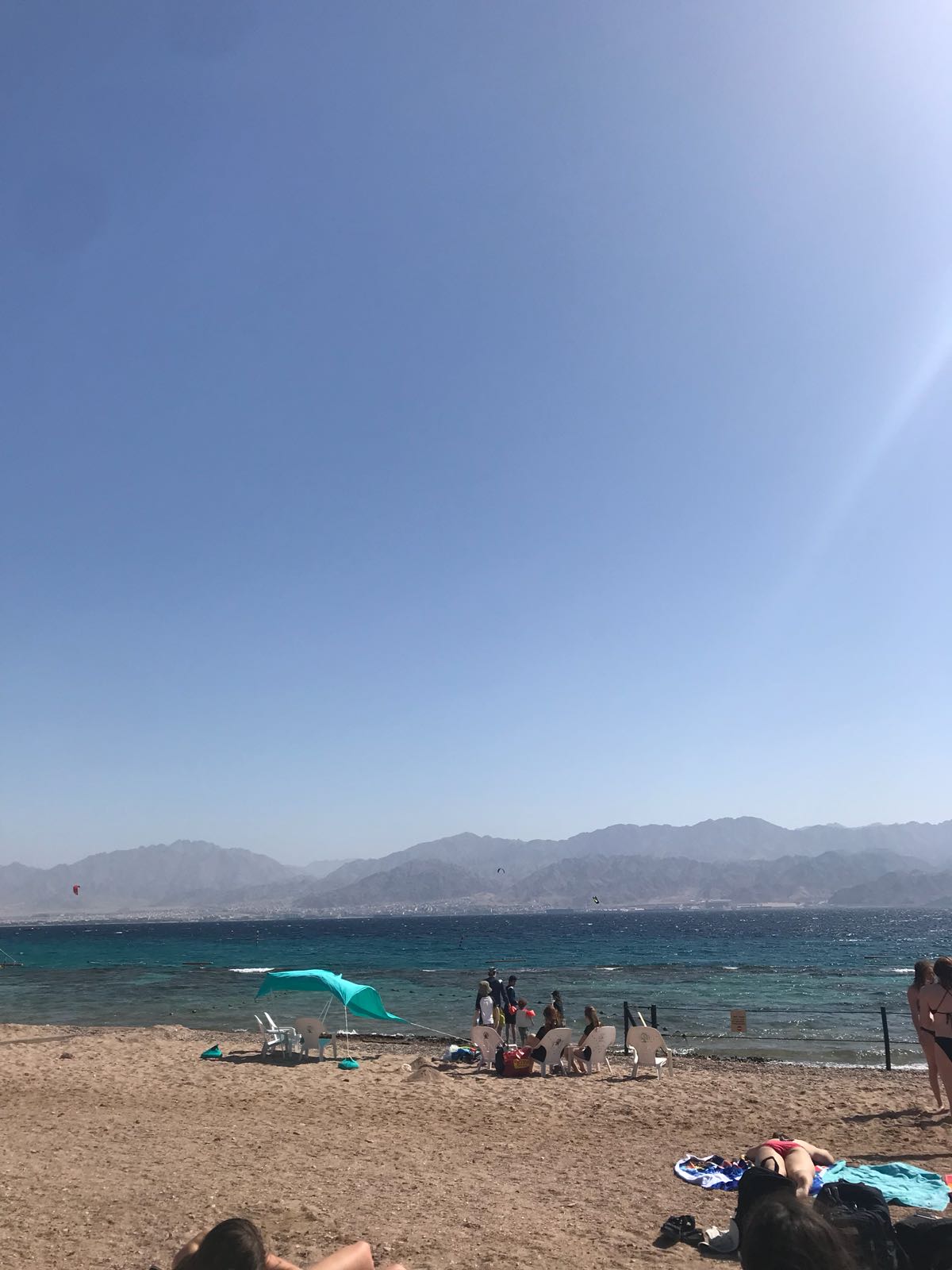
     On Thursday morning we hopped on a bus taking us to snorkel in the sea and observe a natural coral reef. At first, I was hesitant about wearing a life jacket, but it didn't make that big of a difference in the end. Even though the snorkeling went by quickly, we were given enough time to enjoy the beach. Many laid out their towels to enjoy the warm sun and many used the time to get ice cream or take pictures of the beautiful water. Our time at the beach was succeeded by an incredible Purim festival, where we were able to indulge in a plethora of activities and festivities. Everywhere I looked there were people, ranging in all ages, dressed up in this year's costume choice. There was a special performance by Moshe Perez in the center of the festival. People gathered to celebrate Purim and dance to his music. The sun beat down on us as we dance, but we were having to much fun to worry about the heat.
    After the festival, we were given free time on the Promenade to get dinner and shop. Towards the end of the Promenade was a flee market with many stands, mostly all selling similar items. The sun set as we ventured through the Promenade and we thought our night was coming to an end. Then we realized we still had more Purim festivities awaiting us back at the hostel. When we arrived back at the hostel, people rushed to get ready for the night ahead. Before our program started, everyone gathered in the courtyard to take pictures with others in their costumes. We were brought to a room with lights and music for a dance party to finish off the night.
     The next morning we headed out to the sand dunes. The bus ride was long and the treck up the hill was strenuous, but it was all worth it once we reached the top. Some only took pictures while some of us wrestled each other, rolled and ran down the dunes, and made sand angels. It was a very messy experience. Before we got back on the bus, we were sprayed with air to clean off the sand that covered us from head to toe. After the dunes, we headed back to the Promenade for lunch and time at the beach. We headed back to the hostel to get ready for Shabbat when we were done at the beach. For Shabbat services, we sat on the balcony that looked over the sea. Nathan and David led an entertaining service that kept everyone engaged. Later that night, for Oneg Shabbat, we were split into groups of five and given a pen. There is a story about a man who started with a paper clip and continuously traded for more valuable things until he ended up with a house. Our goal was to adventure through the Promenade trying to keep trading up, but instead of a paper clip, we started with a pen. Time flew by in an instant because of the all the fun brought by this experience.
    On Saturday morning we packed our stuff for the journey back home. Before leaving, we split into small groups to discuss the important events in Jewish History. On our way back to Tzuba, we stopped at another reform Kibbutz where we learned about ways to use recyclable items and compost in our daily life.
     I know I had Eilat of fun on this trip, but now I have a question for you. What was your favorite experience in Eilat?


Tuesday, March 6, 2018

Oral Law תושב''ע Assignment

Oral Law (תושב''ע) Assignment

  • Please open the Tanach to ויקרא י"ט (Leviticus 19). Please read the wide range of mitzvot here and choose one mitzvah (commandment) to which you can relate.
  • Please explain why you chose this Mitzvah or pasuk (verse) and build a fence around it. How do you interpret this Mitzvah? How do you or can you fulfill this mitzvah in your daily life? How can it be a guideline for you as a Jew in the modern world?
  • Using a digital camera/phone, please take a photograph that in some way expresses the verse you selected (or use an existing photo). The photo can be a place, a person, something you’ve created, an object in nature, etc… Be creative! The image may only have meaning for you!
  • Write a concluding paragraph explaining how this photograph expresses the Jewish mitzvah/ value you selected.
  • This assignment must be constructed of 2 paragraphs and a picture. 
  • Create your own blog entry each. (Not a comment attached to this post!)
  • The assignment is due by class on Tuesday, March 13.

Sunday, March 4, 2018

Christianity Tiyul- Twiggy

Our morning started out with a change in schedule due to the rain, with our Jewish History classes taking place in the classrooms at the Kibbutz rather than at the location of the tiyul. In the classroom, we learned about the idea of a messiah, and how Christianity stems from the idea of Joshua (known as Jesus) being the messiah. We learned that the Essenes were associated with being Christian, and that the Christian bible is written for Jews by Jews. Jesus is said to have been born in Bethlehem, later becoming Jesus of Nazareth. Jesus’ mom, Mary, was most likely Miriam, and Jesus’ human father figure, Joseph, was probably yosef. Jesus was a Carpenter and a rabbi, making him a faracee.     
             The messiah has to be a descendent of king David in both Judaism and Christianity, and King David is from Bethlehem, which is why it is said that Jesus is from Bethlehem. The Jews didn’t follow Jesus because an abundant amount of people were claiming to be the messiah. There is no evidence that Jesus claimed that he was a messiah however. Accepting virgin birth is a central temple of belief in Christianity, with the idea of immaculate conception stemming from Mary and Jesus. While the Jews believe that the messiah is yet to come, the Christians believe that the messiah (Jesus) has already come, but the people weren’t ready for him, so he was crucified, but he’ll return in a second coming. In Judaism, it’s believed that Elijah the prophet will announce the messiah, whereas in Christianity the messiah will announce their own arrival. Many Jews wonder why the messiah didn’t come during the Holocaust, causing a shift in belief as many Jews lost faith. 
            There are 4 main gospels in Christianity: Matthew, Mark, Luke, and John. They make up the New Testament. We were able to visit two different holy locations in Ein Kerem once we left our classroom, where we saw firsthand the impact of the New Testament, and the entire religion of Christianity.
At the first location, we were able to see the same writing in an array of languages on the walls outside, where people from all over the world observed.
Inside of the church, a service was taking place. The main difference between our synagogues and this church was the images of idols on the glass and walls of the building.

We had the rare opportunity to descend the stairs to a catacomb, an old tomb beneath the church.

At the second holy site, we were able to visually understand the importance of immaculate conception in Christianity, where a famous statue showed two mothers of Christianity meeting at that exact holy site with their pregnant stomachs.
There were more people praying here to images of Mary and Jesus, as they paid their respects to their beliefs in their holy place.


Christianity and Judaism are both very similar and very different. If you weren’t Jewish, and you couldn’t be atheist or unaffiliated with a religion, would you want to be Christian? Or would you choose another religion? Which one and why?

Security Tiyul - Caleb Ernst   Last Wednesday, Kitat Keshet had it's final real tiyul which focused on three main things, Second Intif...